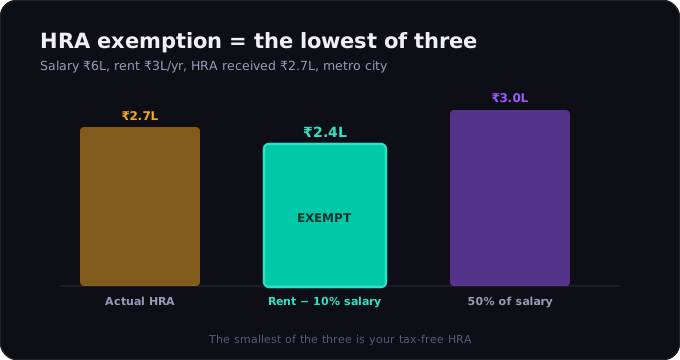
House Rent Allowance (HRA) is one of the largest tax exemptions available to salaried employees — yet it's also one of the most miscalculated. Many people either over-claim (and get a tax notice) or under-claim (and lose thousands each year). The exemption formula has three components and you get the minimum of all three — which means a single wrong number can cost you the entire benefit.
This guide walks through the exact formula, metro vs non-metro rules, all documentation requirements, and strategies to legally maximise your HRA exemption in FY 2026-27.
The HRA Exemption Formula — Exactly
The exempt HRA is the lowest of three values. All three must be calculated; whichever is smallest is the exemption.
The Three-Way Minimum
Component A: Actual HRA received from the employer
Component B: 50% of (Basic Salary + DA) — for metro cities
OR 40% of (Basic Salary + DA) — for all other cities
Component C: Actual rent paid − 10% of (Basic Salary + DA)
Exempt HRA = MIN(A, B, C)
The remainder (Actual HRA received − Exempt HRA) is fully taxable as salary income.
What Counts as "Salary" for HRA?
For HRA purposes, "salary" means Basic Salary + Dearness Allowance (DA). It does NOT include HRA itself, special allowance, bonus, commission (unless forming part of salary), LTA, or medical allowance. Many people use their total CTC or gross salary — that's wrong and leads to inflated claims.
Metro vs Non-Metro: Which Cities Qualify?
Only four cities qualify for the 50% metro HRA rate under Section 10(13A):
- Mumbai (including Thane, Navi Mumbai)
- Delhi (including Gurugram, Noida, Faridabad, Ghaziabad)
- Kolkata
- Chennai
All other cities — including Bangalore, Hyderabad, Pune, Ahmedabad, Surat, Jaipur — are classified as non-metro and get 40%. This surprises many Bangalore IT employees who assume their city qualifies for 50%.
Worked Examples — Five Scenarios
Example 1 — Mumbai, High Rent
Basic Salary: ₹60,000/month | DA: ₹0 | HRA from employer: ₹30,000/month | Rent paid: ₹28,000/month
A = ₹30,000 (actual HRA)
B = 50% × ₹60,000 = ₹30,000 (metro)
C = ₹28,000 − 10% × ₹60,000 = ₹28,000 − ₹6,000 = ₹22,000
Exempt = MIN(30,000, 30,000, 22,000) = ₹22,000/month = ₹2,64,000/year
Taxable HRA = ₹30,000 − ₹22,000 = ₹8,000/month
Example 2 — Bangalore (Non-Metro), Moderate Rent
Basic: ₹80,000/month | DA: ₹0 | HRA: ₹32,000/month | Rent: ₹25,000/month
A = ₹32,000
B = 40% × ₹80,000 = ₹32,000 (non-metro)
C = ₹25,000 − 10% × ₹80,000 = ₹25,000 − ₹8,000 = ₹17,000
Exempt = MIN(32,000, 32,000, 17,000) = ₹17,000/month = ₹2,04,000/year
Note: Despite paying ₹25,000 rent, the exemption is only ₹17,000 — the 10% basic deduction is significant.
Example 3 — Small City, Full Exemption
Basic: ₹40,000/month | DA: ₹5,000 | HRA: ₹15,000/month | Rent: ₹18,000/month
A = ₹15,000
B = 40% × ₹45,000 = ₹18,000 (non-metro)
C = ₹18,000 − 10% × ₹45,000 = ₹18,000 − ₹4,500 = ₹13,500
Exempt = MIN(15,000, 18,000, 13,500) = ₹13,500/month
Example 4 — What Happens When You Pay More Rent Than HRA
Basic: ₹1,00,000/month | HRA from employer: ₹20,000/month | Rent: ₹50,000/month (Delhi)
A = ₹20,000
B = 50% × ₹1,00,000 = ₹50,000
C = ₹50,000 − 10% × ₹1,00,000 = ₹50,000 − ₹10,000 = ₹40,000
Exempt = MIN(20,000, 50,000, 40,000) = ₹20,000/month
Even though rent is ₹50K and B is ₹50K, the HRA received (₹20K) caps the exemption. This is common in companies that give low HRA components.
Paying Rent to Parents — Is It Legal?
Yes — with strict conditions. The arrangement must be genuine:
- The house must legally belong to your parent (in their name)
- You must have a proper rent agreement signed and notarised
- Rent must be paid via bank transfer (not cash) for traceability
- Your parent must declare the rental income in their ITR
- If your parent is in a lower tax bracket (or below exemption limit), this can be very tax-efficient as a family
What you cannot do: Pay rent to a spouse. The Income Tax Act specifically disallows HRA claims where rent is paid to a spouse, as the property is considered a shared marital asset.
PAN of Landlord: When Is It Mandatory?
If your annual rent exceeds ₹1,00,000 (i.e., ₹8,334/month or more), you must provide your landlord's PAN to your employer (Form 12BB). If the landlord doesn't have a PAN, get a written declaration from them stating they don't have one.
For rent below ₹1 lakh annually, PAN is not required — but rent receipts are still needed for your employer and must be kept for potential scrutiny.
HRA + Home Loan: Can You Claim Both?
One of the most common questions: can you claim HRA exemption while also claiming home loan interest deduction under Section 24(b)?
The answer is yes, in certain situations:
- Different cities: If you work in Mumbai and own a home in Delhi, you can claim HRA for Mumbai rent AND home loan interest for the Delhi property.
- Property under construction: If your owned flat is being built (pre-possession), you're renting elsewhere and can claim HRA. Post-possession, the pre-EMI interest is deductible over 5 equal instalments.
- Property rented out: If you own a property but rent it out and live in rented accommodation yourself, both HRA exemption and home loan interest deduction can apply.
What's not allowed: Claiming HRA while living in your own house (that you own and occupy) in the same city.
Section 80GG: For Those Without HRA in Salary
If your salary doesn't include an HRA component (some companies structure CTC without HRA), you can claim rent deduction under Section 80GG:
- Deduction: Lowest of (a) ₹5,000/month, (b) 25% of adjusted total income, (c) rent − 10% of adjusted total income
- Condition: You (or spouse or minor child) must not own any residential property in the city where you work or reside
- You must file Form 10BA
80GG is significantly less generous than HRA exemption, but it's the only option if your employer doesn't give HRA.
Documents Required for HRA Claim
- Rent receipts — monthly, with ₹1 revenue stamp if rent is above ₹5,000/month (bank transfer receipts also acceptable)
- Rent agreement — registered or notarised, with your name, landlord's name, property address, and monthly rent
- Landlord's PAN — if annual rent exceeds ₹1 lakh
- Form 12BB — declaration submitted to your employer each year
Keep all documents for at least 6 years — the IT department can send scrutiny notices up to 6 years after assessment.
Frequently Asked Questions
What is the HRA exemption formula?
HRA exemption = MINIMUM of (A) Actual HRA received, (B) 50% or 40% of Basic+DA based on city, and (C) Actual rent paid − 10% of Basic+DA.
Is HRA available under the New Tax Regime?
No. HRA exemption is only available under the Old Tax Regime.
Which cities are metro for HRA purposes?
Only Mumbai, Delhi, Kolkata, and Chennai. Bangalore, Hyderabad, Pune etc. are non-metro (40%).
Can I claim HRA and home loan interest together?
Yes, if your rented home and owned property are in different cities, or if your owned property is rented out or under construction.
Can I pay rent to parents and claim HRA?
Yes, provided the arrangement is genuine, documented, and your parent declares the rental income in their ITR. Cannot be paid to a spouse.
When is the landlord's PAN mandatory?
When annual rent exceeds ₹1,00,000. Below that, only rent receipts are needed.
What if my employer doesn't give HRA?
You can claim rent deduction under Section 80GG (up to ₹5,000/month) if no HRA component is in your salary.
What is Form 12BB?
Form 12BB is the declaration form you submit to your employer at the start of the financial year declaring your intended tax-saving investments and HRA claim. It helps your employer calculate correct TDS.
Data sources: Section 10(13A) of the Income Tax Act, 1961; CBDT Circular on HRA; Finance Act 2025. For educational purposes only — consult a CA for personalised advice.
Official Sources
Related Articles
Official sources
Every rate and threshold in this guide is checked against the official government sources below. Always confirm figures for your own situation before filing.