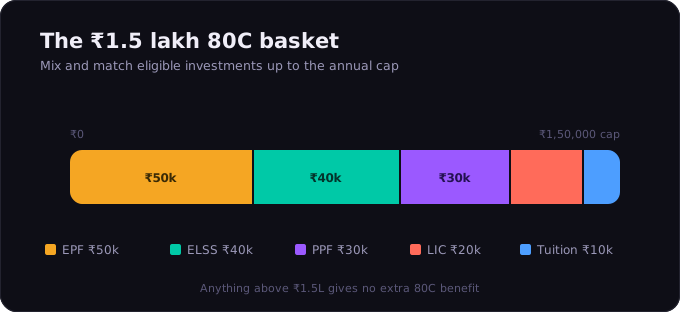
Every salaried Indian knows the Section 80C rush in March — scrambling to show investment proofs before the deadline. But most people treat 80C as a checkbox, not a strategy. Done right, 80C alone can save you ₹46,800 in tax (₹1.5L × 31.2% for the ₹10-15L slab). Layer in 80D, 80CCD(1B), and 80G, and the savings can cross ₹1 lakh a year.
This guide covers every eligible instrument, the smart stacking strategy, regime choice implications, and the traps that catch most taxpayers.
What is Section 80C?
Section 80C of the Income Tax Act, 1961 allows individuals and HUFs (Hindu Undivided Families) to deduct up to ₹1,50,000 from their gross total income by investing in specified instruments or making specified payments. The deduction directly reduces your taxable income — it doesn't give you a credit, it reduces the income on which tax is calculated.
For a person in the 30% slab (income above ₹10 lakh in the Old Regime), the maximum tax saving from full 80C utilisation is:
Maximum Tax Saving from 80C
₹1,50,000 × 30% (tax rate) = ₹45,000 + ₹4,500 (4% cess) = ₹46,800 saved
For 20% slab (₹5-10L): ₹1,50,000 × 20% = ₹30,000 + ₹1,200 cess = ₹31,200 saved
For 5% slab (₹2.5-5L): ₹1,50,000 × 5% = ₹7,500 + ₹300 cess = ₹7,800 saved
Complete List of 80C Eligible Instruments (2025-26)
The ₹1.5 lakh limit is cumulative across ALL instruments below. You can mix and match.
Savings & Investment Instruments
| Instrument | Lock-in | Return Type | Interest Rate (2025) |
|---|---|---|---|
| PPF (Public Provident Fund) | 15 years | Tax-free, guaranteed | 7.1% p.a. |
| ELSS (Equity-Linked Savings Scheme) | 3 years | Market-linked | Varies (12-15% historical avg) |
| NSC (National Savings Certificate) | 5 years | Taxable, guaranteed | 7.7% p.a. |
| Tax-saving FD (5-year) | 5 years | Taxable, guaranteed | 6.5-7.5% (bank-dependent) |
| Sukanya Samriddhi Yojana (SSY) | Till girl turns 21 | Tax-free, guaranteed | 8.2% p.a. |
| Senior Citizens Savings Scheme (SCSS) | 5 years | Taxable, guaranteed | 8.2% p.a. |
| Post Office Time Deposit (5yr) | 5 years | Taxable, guaranteed | 7.5% p.a. |
Insurance & Retirement
| Instrument | Notes |
|---|---|
| LIC Premium / Life Insurance | Premium must be ≤ 10% of sum assured (policies from 2012+). Only own/spouse/children premiums qualify. |
| ULIPs (Unit Linked Insurance Plans) | Subject to IRDAI lock-in of 5 years. Premium ≤ 10% of sum assured rule applies. |
| EPF (Employee Provident Fund) | Your own 12% contribution auto-qualifies. Employer's share does NOT count toward 80C. |
| VPF (Voluntary Provident Fund) | Additional contributions over 12% — same EPF tax treatment. |
| NPS (National Pension System) — 80CCD(1) | Up to 10% of salary (salaried) or 20% of gross income (self-employed), but within the ₹1.5L 80C ceiling. |
Loan Repayments & Fees
| Payment | Condition |
|---|---|
| Home Loan Principal Repayment | Only for self-occupied or let-out property. Property must not be sold within 5 years of possession. |
| Stamp Duty & Registration Charges | Claimable in the year of purchase. One-time benefit. |
| Children's Tuition Fees | Full-time education in India only, up to 2 children. Does NOT include coaching/tutorial fees. |
Beyond 80C: The Full Deduction Stack
80C is just the start. Savvy taxpayers claim multiple sections simultaneously. Here's the full stack available under the Old Regime:
Section-by-Section Deduction Stack (Old Regime)
| Section | What it covers | Limit |
|---|---|---|
| 80C | Investments, insurance, loan principal, fees | ₹1,50,000 |
| 80CCC | Pension plan premium (LIC Jeevan Nidhi type) | Within 80C limit |
| 80CCD(1) | NPS own contribution | Within 80C limit |
| 80CCD(1B) | NPS extra self-contribution — OVER AND ABOVE 80C | ₹50,000 additional |
| 80D | Health insurance premium (self + family) | ₹25,000 (+ ₹25,000 for parents / ₹50,000 if senior citizen) |
| 80DD | Medical treatment of disabled dependent | ₹75,000 / ₹1,25,000 (severe disability) |
| 80DDB | Treatment of specified diseases (cancer, etc.) | ₹40,000 / ₹1,00,000 (senior citizen) |
| 80E | Interest on education loan (self/spouse/children) | No limit, for 8 years |
| 80EEA | Additional home loan interest (affordable housing) | ₹1,50,000 extra |
| 80G | Donations to approved funds/charities | 50% or 100% of donation |
| 80TTA | Interest on savings account | ₹10,000 |
| 80TTB | Interest on deposits (for senior citizens) | ₹50,000 |
The 80CCD(1B) is often missed — it gives you an extra ₹50,000 deduction on top of the ₹1.5L ceiling, exclusively for NPS contributions. For someone in the 30% bracket, that's ₹15,600 of additional tax saving.
The ELSS vs PPF Debate
This is the most common 80C question, and the answer depends on your time horizon and risk appetite.
ELSS vs PPF: Side-by-Side
| Feature | ELSS | PPF |
|---|---|---|
| Lock-in period | 3 years | 15 years (partial after 7) |
| Returns | Market-linked (12-18% historical; can be negative in bad years) | 7.1% p.a. (government set, quarterly) |
| Tax on returns | LTCG above ₹1.25L @ 12.5% | Completely tax-free (EEE) |
| Risk | High (equity market) | Zero (government backed) |
| Liquidity | After 3 years | After 7 years (partial); full at 15 |
| Best for | Young investors, long-term wealth creation | Risk-averse, nearing retirement, guaranteed returns |
Practical strategy: Age 25-40 → 60-70% ELSS + 30-40% PPF. Age 40+ → shift more to PPF/NSC. Always hold ELSS for 5+ years to ride out market cycles.
Smart 80C Strategy: What Most People Get Wrong
1. Over-insuring for 80C — Many people buy expensive endowment or ULIP policies just for 80C. These give poor returns (4-5% p.a.) with high charges. A better approach: buy term insurance (pure protection, cheap) + invest the savings in PPF/ELSS for 80C.
2. Ignoring mandatory EPF contribution — If your employer deducts EPF, your 12% employee contribution is already 80C eligible. A person earning ₹8L p.a. basic contributes ~₹57,600 to EPF annually — that's ₹57,600 of your ₹1.5L limit already filled without any effort.
3. Not timing NSC accrued interest — Interest on NSC accrues annually and is reinvested. This reinvested interest counts as a fresh 80C investment each year. So if you bought NSC 2 years ago, the interest reinvested last year also reduces your taxable income.
4. Missing tuition fees — School/college tuition fees for up to 2 children are 80C eligible. Many parents don't claim this. Note: it must be tuition fees specifically — not development fees, mess charges, or coaching.
5. Home loan principal + stamp duty — If you bought a house this year, the stamp duty and registration charges are claimable in the year of purchase — but only once. And the principal repayment qualifies annually. Don't double-claim stamp duty.
Full Deduction Example — Priya, ₹15L Salary (Old Regime)
| Deduction | Amount |
|---|---|
| Standard Deduction | ₹75,000 |
| 80C: EPF own contribution (12% of ₹8L basic) | ₹96,000 |
| 80C: ELSS top-up | ₹54,000 (to reach ₹1.5L limit) |
| 80CCD(1B): NPS extra contribution | ₹50,000 |
| 80D: Health insurance (self + family) | ₹25,000 |
| 80D: Parents' health insurance | ₹25,000 |
| Total Deductions | ₹3,25,000 |
Gross salary: ₹15,00,000 → Taxable income after deductions: ₹11,75,000
Tax saving vs. zero deductions: approximately ₹78,000
Old Regime vs New Regime: When Does 80C Win?
Since FY 2023-24, the New Regime is the default. It offers lower slab rates but NO deductions. The question is: do your deductions save more tax than the lower rates of the New Regime?
Break-Even Analysis
| Income | New Regime Tax | Old Regime Tax (after full 80C + 80D + NPS) | Old Regime Better? |
|---|---|---|---|
| ₹7L | ₹0 (rebate) | ₹0 (rebate) | Tie |
| ₹10L | ₹54,600 | ~₹37,400 (with ₹2.75L deductions) | ✅ Yes |
| ₹15L | ₹1,09,200 | ~₹78,000 (with ₹3.25L deductions) | ✅ Yes |
| ₹12L | ₹0 (rebate under New 2025 budget) | ~₹15,000 | ❌ No |
The New Budget 2025 made the New Regime very attractive for incomes up to ₹12 lakh (zero tax via 87A rebate). For ₹12-15L range, run the numbers carefully — Old Regime often still wins if you have high deductions.
Home Loan Principal + 80C: What You Can & Cannot Claim
If you have a home loan, the principal repayment qualifies under 80C — but there are critical conditions most people overlook:
- The property must not be sold within 5 years of possession. If sold before 5 years, all 80C deductions claimed are added back to income in the year of sale.
- Both self-occupied and let-out properties qualify for the principal deduction.
- The interest on a home loan is not 80C — it's deductible under Section 24(b) (up to ₹2 lakh for self-occupied) separately.
- Pre-EMI interest during construction is deductible over 5 years starting the year of possession.
Sukanya Samriddhi Yojana (SSY) — The Hidden Gem
If you have a daughter below age 10, SSY is arguably the best tax-saving instrument available:
- Rate: 8.2% p.a. (one of the highest guaranteed rates)
- Tax treatment: EEE — Exempt at investment (80C), Exempt on interest accrual, Exempt at maturity
- Minimum: ₹250/year. Maximum: ₹1.5 lakh/year
- Tenure: Account matures when girl turns 21. Deposits required for 15 years.
- Partial withdrawal: 50% allowed after girl turns 18 for education
Frequently Asked Questions
Is 80C available under the New Tax Regime?
No. Section 80C deductions are not available under the New Tax Regime. You must opt for the Old Tax Regime to claim 80C.
What is the maximum 80C deduction limit?
₹1,50,000 (₹1.5 lakh) per financial year, combined across all eligible instruments.
Can I claim 80C on EPF contribution?
Yes — your own (employee) EPF contribution qualifies. The employer's contribution does not count toward your 80C limit.
Is ELSS better than PPF for 80C?
ELSS has a shorter 3-year lock-in and potentially higher returns but carries market risk. PPF gives guaranteed, tax-free returns over 15 years. Best practice: blend both based on your age and risk appetite.
Can I claim 80C and 80D together?
Yes — 80C and 80D are separate sections with separate limits. Both can be claimed simultaneously under the Old Regime.
What is Section 80CCD(1B)?
It's an additional deduction of up to ₹50,000 for NPS contributions — over and above the ₹1.5 lakh 80C ceiling. It's one of the best ways to increase total deductions beyond ₹1.5L.
Data sources: Income Tax Act, 1961 (as amended by Finance Act 2025); NSDL/CDSL for NPS; EPFO for EPF rates; National Savings Institute for PPF/NSC/SSY rates. Rates as of April 2025. This guide is for educational purposes — consult a chartered accountant for personalised advice.
Official Sources
Related Articles
Official sources
Every rate and threshold in this guide is checked against the official government sources below. Always confirm figures for your own situation before filing.